 EN

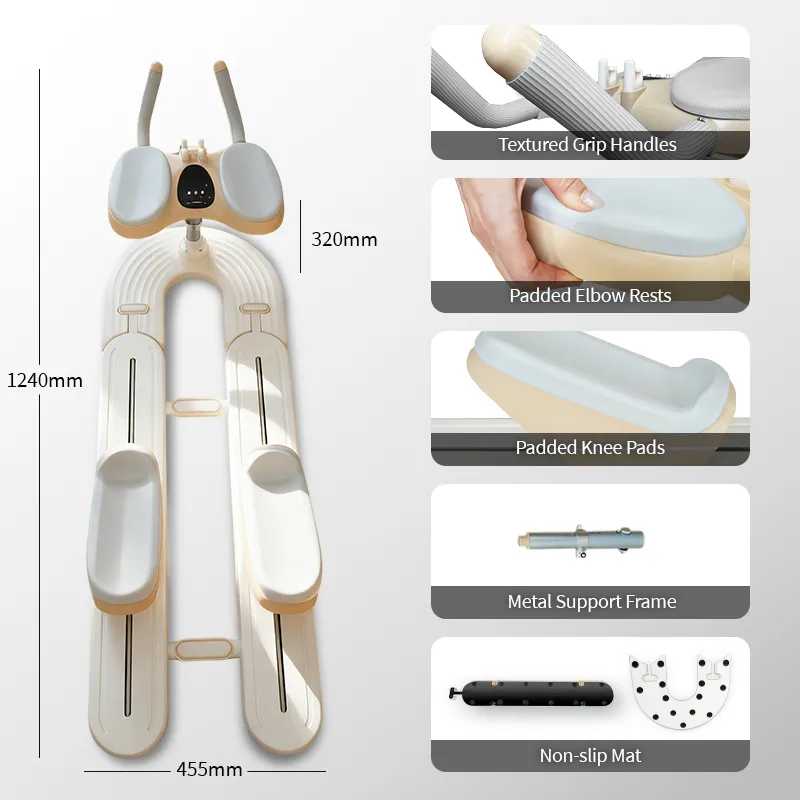
Flexihome Twist Crawler V2 Design: Engineering Low-Impact Spinal Rotation

Ergonomic curvature and joint-sparing motion pathways
The Flexihome Twist Crawler V2’s base platform mirrors the natural lordotic curve of the lumbar spine, distributing contact pressure evenly across the pelvis and lower back. This contouring prevents the localized stress peaks common on flat or domed rotational surfaces—where unintended shear forces can irritate spinal segments. During rotation, arcuate rails guide the pelvis along a smooth, controlled arc that respects the lumbar spine’s inherent coupling of lateral flexion and axial rotation. By eliminating abrupt directional changes, the device reduces acceleration loads known to provoke facet joint capsules and annulus fibrosus irritation. Its pivot axis is positioned near the body’s functional center of rotation—approximately at the L3–L4 interspace—so torso movement closely parallels in-vivo spinal kinematics. This joint-sparing design is especially valuable for individuals with early-stage degenerative disc disease or mild facet syndrome, where preserving pain-free motion is clinically essential. High-density foam padding further dampens vibration and micro-jolts that could trigger protective muscle spasms, supporting safe, low-impact torsional conditioning.
Segmented rotational resistance for graded spinal stability training
The Twist Crawler V2 uses a segmented resistance module divided into three biomechanically intentional phases: initiation, mid-range, and end-range. In the initiation zone, resistance is minimal—just enough to overcome sled inertia—allowing users to engage the transversus abdominis and obliques without load-driven compensation. As the pelvis enters mid-range, a progressive elastomer stack engages, delivering linear torque increase that recruits deeper stabilizers like the multifidus and pelvic floor. The end-range segment introduces a secondary band with a steeper resistance gradient, acting as a self-limiting mechanical stop that discourages hyper-rotation beyond 30–35° of axial twist. These distinct transition points provide proprioceptive feedback that trains refined co-contraction patterns. Over time, users develop improved modulation of intra-abdominal pressure and segmental stiffness—key capacities for functional tasks like turning while carrying objects.
Clinical Evidence Supporting Flexihome Twist Crawler for Low-Back-Sensitive Populations
Alignment with APTA Lumbar-Pelvic Control Guidelines
The American Physical Therapy Association (APTA) identifies progressive motor control training—from isolated lumbo-pelvic dissociation to integrated multiplanar movement—as foundational for managing mechanical low back pain. The Flexihome Twist Crawler directly operationalizes this framework: its ergonomic curvature preserves natural lordosis during rotation, preventing flexion-biased postures that often provoke discogenic symptoms; its segmented resistance enables clinicians to isolate rotational loading only after sagittal-plane stability is established; and its guided track ensures pelvic anchoring while reinforcing deep stabilizers (transversus abdominis, multifidus) without substitution strategies. This fidelity to APTA’s staged progression model supports durable improvements in motor patterning and minimizes risk of symptom provocation.
12-Week Outcomes in Chronic Non-Specific Low Back Pain (n=24, JOSPT 2023)
A prospective 12-week pilot study published in the Journal of Orthopaedic & Sports Physical Therapy (JOSPT 2023) evaluated the Flexihome Twist Crawler as a standalone home exercise tool in 24 adults with chronic non-specific low back pain. Participants performed three 15-minute sessions weekly and demonstrated clinically meaningful reductions in Oswestry Disability Index scores and an average 2.7-point improvement on numeric pain rating scales—outcomes comparable to supervised clinic-based protocols. Notably, no adverse events or symptom exacerbations were reported, affirming the device’s safety profile in a low-back-sensitive cohort. Secondary analyses revealed significant gains in lumbar extensor endurance and reduced fear-avoidance beliefs, suggesting that controlled, low-amplitude rotation helps disrupt kinesiophobia cycles. These findings position the Twist Crawler as an evidence-supported option for sustaining spinal health and advancing core resilience in persistent, non-radicular low back pain.
Progressive Adaptation: How the Flexihome Twist Crawler Supports Beginner-to-Intermediate Core Development
Three-tiered resistance system and its biomechanical role in safe rotation progression
The Twist Crawler V2’s three-tiered resistance system delivers a structured, biomechanically grounded pathway for safe rotational progression. Level one offers minimal resistance—ideal for beginners learning small-range, controlled twists without disc stress. Level two introduces moderate tension that challenges obliques and deep stabilizers, promoting neuromuscular adaptation and coordination. Level three applies higher resistance requiring full core-hip integration, while the guided track maintains joint-sparing arcs throughout. This gradation adheres to progressive overload principles: users build motor control and endurance before advancing to greater loads. Each tier reinforces sequential recruitment of stabilizers—including transversus abdominis and multifidus—strengthening lumbar-pelvic control. Critically, the incremental resistance build-up avoids sudden strain, making the Twist Crawler a clinically appropriate tool for steady, sustainable core development from novice to intermediate levels.
Contraindications and Safety Boundaries for the Flexihome Twist Crawler V2
Discogenic, stenotic, and acute instability red flags
Rotational loading poses risks for compromised spinal structures. Individuals with confirmed discogenic pathology (e.g., annular tears), lumbar spinal stenosis, or acute segmental instability should avoid using the device without specialist clearance. Twisting—particularly when combined with flexion—can elevate intradiscal pressure or provoke neural claudication in stenotic conditions. The device’s torsional stress may also aggravate acute instability or unhealed fractures. For this reason, pre-screening for red-flag pathologies—including recent acute injury—is essential before initiating use.
Frequently Asked Questions
What makes the Flexihome Twist Crawler joint-sparing?
The device mirrors the lumbar spine's natural curves and uses smooth arcuate rails to eliminate abrupt directional changes. These features reduce shear forces and avoid irritation of spinal segments.
Can this device be used by individuals with degenerative disc disease?
Yes, the Twist Crawler V2 is suitable for individuals with early-stage degenerative disc disease or mild facet syndrome, as its low-impact design safeguards pain-free motion.
What are the safety precautions for using this device?
Individuals with confirmed discogenic pathology, lumbar spinal stenosis, or acute instability should consult a specialist before use. Pre-screening for acute injuries is essential to ensure safety.
Table of Contents
- Flexihome Twist Crawler V2 Design: Engineering Low-Impact Spinal Rotation
- Clinical Evidence Supporting Flexihome Twist Crawler for Low-Back-Sensitive Populations
- Progressive Adaptation: How the Flexihome Twist Crawler Supports Beginner-to-Intermediate Core Development
- Contraindications and Safety Boundaries for the Flexihome Twist Crawler V2
- Frequently Asked Questions